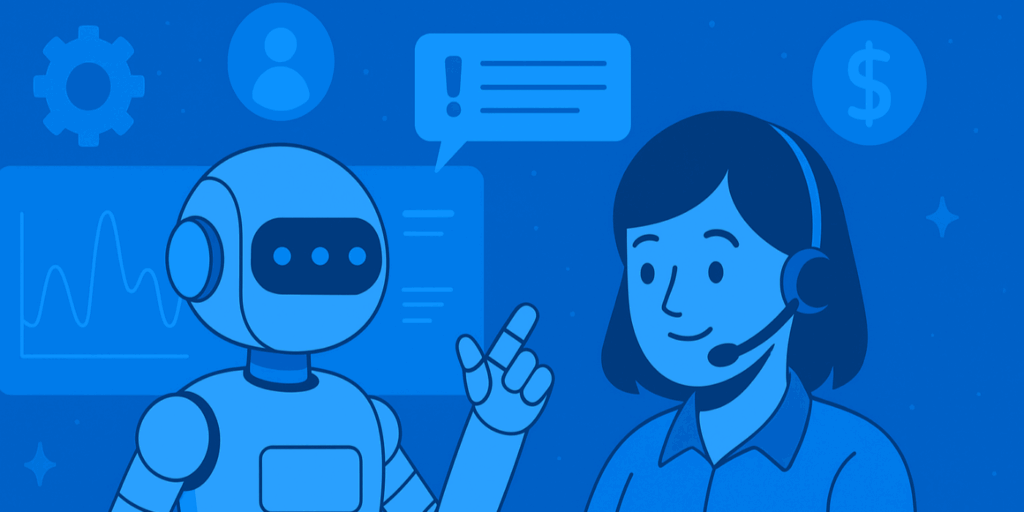
Your labor line is bloated not because people are lazy, but because your stack still treats every call like it’s 2013. Voice AI coaching, AI agent assist, AI call scoring, and contact center automation can remove hours of manual effort per agent per week—but only if you map them to very specific jobs humans shouldn’t be doing anymore. This guide gives you 100 concrete AI tool patterns that directly cut handle time, shrink QA headcount, and stop you hiring 10 extra people just to keep up with tickets. Use it as a build sheet for an AI-first contact center sitting on top of a resilient core call center platform.
We’ll group the tools into 4 big labor killers: voice AI coaching, AI agent assist, AI call scoring & QA, and automation bots that attack wrap-up, back-office work, and low-value contacts. Every line below is something you either already pay humans to do—or something you avoid doing because it’s too expensive.
| # | AI Tool Pattern | Human Work It Replaces / Shrinks | Category |
|---|---|---|---|
| 1 | Real-time voice AI coaching overlay | Supervisor whispering on live calls | Voice AI coaching |
| 2 | Objection-handling suggestion engine | Script binders + manual training | Agent assist |
| 3 | Live sentiment heatmap per call | Post-call “vibe checks” by leads | AI call scoring |
| 4 | Auto-generated after-call summaries | Agents typing long wrap-up notes | Automation |
| 5 | Knowledge-base answer suggester | Agents searching wikis during calls | Agent assist |
| 6 | Real-time compliance script checker | Supervisors shadowing for disclaimers | AI QA |
| 7 | Dynamic call opening coach | Weeks of onboarding roleplays | Voice AI coaching |
| 8 | AI-guided discovery question tree | Manual discovery checklists | Agent assist |
| 9 | Real-time upsell cross-sell trigger hints | Agents remembering upsell rules | Voice AI coaching |
| 10 | AI-powered empathy coaching prompts | Soft-skill classroom workshops | Voice AI coaching |
| 11 | On-call translation for multilingual support | Extra language-specialist hires | Agent assist |
| 12 | AI accent normalisation for clarity | Callbacks due to “I didn’t get that” | Voice AI |
| 13 | Real-time policy lookup assistant | Policy desk escalations | Agent assist |
| 14 | AI first-call resolution playbook recommender | Leads coaching after repeat contacts | Voice AI coaching |
| 15 | Auto-call reason classification | Agents choosing manual reason codes | Automation/analytics |
| 16 | Dynamic script branching engine | Static paper scripts | Agent assist |
| 17 | Real-time “do not say” phrase guard | Manual coaching after complaints | AI QA |
| 18 | AI voice bot for FAQ deflection | Agents answering simple FAQs | Automation |
| 19 | Callback scheduling bot | Agents negotiating callback slots | Automation |
| 20 | AI-powered voice containment IVR | Transfers from dumb IVR menus | Automation |
| 21 | Real-time fraud phrase detection | Specialist fraud monitors | AI QA |
| 22 | AI-assisted ID verification flow | Manual security Q&A length | Agent assist |
| 23 | Real-time “next best action” engine | Supervisors deciding step-by-step | Agent assist |
| 24 | Tone and pacing coaching | Soft-skill workshops and side-jacks | Voice AI coaching |
| 25 | AI script A/B testing optimizer | Analysts crunching script data manually | Analytics/automation |
| 26 | Auto-prioritisation of queues by value | Manual reordering of queues | Routing AI |
| 27 | AI callback time prediction | Planners estimating SLAs on spreadsheets | Workforce AI |
| 28 | Dynamic auto-wrap timing by call type | Static wrap timers too long | Automation |
| 29 | AI intent detection on call start | Agents spending time probing basics | Agent assist |
| 30 | Queue triage voice bot | Tier-1 agents doing pure routing | Automation |
| 31 | Real-time churn risk scoring per call | Analysts tagging risky contacts later | AI call scoring |
| 32 | AI escalation recommendation engine | Agents guessing when to escalate | Agent assist |
| 33 | “Save offer” script generator | Retention specialists drafting offers | Voice AI coaching |
| 34 | AI-powered refund policy enforcement | Manual policy policing by leads | AI QA |
| 35 | Auto-tagging calls with product features | Analysts listening for product mentions | Analytics |
| 36 | AI-generated follow-up email drafts | Agents writing recap emails | Automation |
| 37 | Collections call scripting bot | Compliance rewriting collections scripts | Agent assist |
| 38 | AI promise-to-pay tracker from calls | Agents logging promises manually | AI QA/automation |
| 39 | “At-risk” escalation routing AI | Manual warm transfers by agents | Routing AI |
| 40 | AI-driven language routing | Static IVR language menus | Routing AI |
| 41 | AI QA auto-scorecards | Humans sampling 2–5% of calls | AI QA |
| 42 | Real-time coaching on dead air | Post-hoc coaching on silence time | Voice AI coaching |
| 43 | AI “talk-listen” ratio optimizer | Supervisors listening for ratios | AI call scoring |
| 44 | Auto-detection of policy disclosures | Manual QA checklists | AI QA |
| 45 | AI-driven handle time outlier alerts | Analysts scanning for long calls | Analytics |
| 46 | Real-time sales script compliance coach | Live monitoring of pitches | AI QA |
| 47 | AI mute-time coaching | Leads reviewing call recordings | Voice AI coaching |
| 48 | AI dispute likelihood detection | Analysts tagging risky calls | AI call scoring |
| 49 | Real-time legal phrase enforcement | Compliance reviewing escalations | AI QA |
| 50 | AI QA calibration assistant | Calibration sessions with many QA FTEs | AI QA |
| 51 | Workforce AI intraday re-forecasting | WFM teams redoing plans hourly | WFM AI |
| 52 | AI shrinkage prediction | Manual shrinkage spreadsheets | WFM AI |
| 53 | Auto-scheduling for breaks and lunches | Supervisors micro-managing schedules | WFM AI |
| 54 | AI-powered shift bidding | WFM handling bids manually | WFM AI |
| 55 | Real-time occupancy optimisation | Leads moving people between queues | Routing/WFM AI |
| 56 | AI-based “who to hire next” profile | Recruiters guessing ideal profiles | People analytics |
| 57 | Attrition risk prediction for agents | HR chasing surprise exits | People analytics |
| 58 | AI coaching plan generator | Leads designing plans per agent | Voice AI coaching |
| 59 | New-hire ramp time predictor | Manual ramp tracking | People analytics |
| 60 | AI gamification engine for KPIs | Coaches manually creating contests | Engagement AI |
| 61 | AI-powered speech analytics dashboard | Analysts hand-tagging transcripts | Analytics |
| 62 | Real-time trend detection (issues/products) | Weekly manual reviews | Analytics |
| 63 | AI “root cause” explorer | War rooms analysing repeat issues | Analytics |
| 64 | Auto-building CX reports for execs | BI teams building decks | Automation |
| 65 | AI alerting on SLA breach risk | Humans watching dashboards all day | Analytics/WFM |
| 66 | AI chatbot for simple web queries | Chat agents answering basic FAQs | Automation |
| 67 | Voice-to-chat escalation bot | Agents manually switching channels | Omnichannel AI |
| 68 | AI “where is my order” deflection bot | Agents answering WISMO | Automation |
| 69 | AI appointment booking assistant | Agents booking via multiple systems | Automation |
| 70 | AI billing inquiry bot | Agents handling tier-1 billing questions | Automation |
| 71 | AI-order-change self-service flow | Agents editing simple orders | Automation |
| 72 | AI address/phone update bot | Agents updating contact details | Automation |
| 73 | AI password reset flow | Agents doing resets | Automation |
| 74 | AI proactive outage notification calls | Agents handling flood of outage calls | Automation |
| 75 | AI refund eligibility bot | Agents checking refund rules | Automation |
| 76 | AI NPS survey dialer bot | Agents calling for surveys | Automation |
| 77 | AI CSAT comment summariser | Analysts reading raw comments | Analytics |
| 78 | AI promoter cross-sell identifier | Manual scanning for promoters | AI call scoring |
| 79 | AI detractor rescue routing | Manual follow-up on bad CSAT | Routing AI |
| 80 | AI “voice of customer” board summaries | CX leaders writing board decks | Automation |
| 81 | AI escalated-case summariser | Tier-2 reading long histories | Automation |
| 82 | AI “single-pane” context composer | Agents opening many systems | Agent assist |
| 83 | AI contract/terms explainer | Legal/ops handholding agents | Agent assist |
| 84 | AI product compatibility checker | Agents cross-checking specs | Agent assist |
| 85 | AI “next best channel” recommender | Humans deciding call vs. chat vs. email | Omnichannel AI |
| 86 | AI repeat-contact predictor | Analysts modelling repeat reasons | Analytics |
| 87 | AI misroute detection | Humans analysing transfer chains | Routing AI |
| 88 | AI backlog-clearing prioritiser | Leads picking backlog manually | Analytics/automation |
| 89 | AI seasonality forecaster | Analysts building seasonal models | Analytics |
| 90 | AI “playbook library” recommender | Supervisors manually suggesting plays | Voice AI coaching |
| 91 | AI-driven dialer pacing optimiser | Ops tuning dialer pacing by hand | Dialer AI |
| 92 | AI local-time-aware dialing windows | Humans building country lists | Dialer AI |
| 93 | AI contact strategy experiment engine | Ops running manual A/Bs | Dialer AI |
| 94 | AI lead-value scoring for dialer lists | Analysts scoring leads offline | Dialer AI |
| 95 | AI “burn risk” alert for lists | Compliance monitoring manual over-dialing | Dialer AI/QA |
| 96 | AI campaign profitability calculator | Finance modelling per campaign | Analytics |
| 97 | AI “what if” staffing simulator | WFM running scenarios manually | WFM AI |
| 98 | Real-time labor-cost per queue tracker | BI computing cost views monthly | Analytics |
| 99 | AI overtime need predictor | Supervisors guessing overtime | WFM AI |
| 100 | AI “labor vs automation” recommendation engine | Strategy teams debating manually | Analytics/automation |
1) Why AI Tools Are Now the Only Real Lever on Labor Cost
You can’t keep shaving pennies off hourly rates while handle time bloats and QA backlogs grow. The only sustainable way to cut labor is to change the unit economics of each contact: lower average handle time, higher first-contact resolution, and fewer humans involved in QA, coaching, and routing. That’s exactly what modern AI stacks do when they sit on reliable cloud call center software that doesn’t fall apart as volume spikes.
The mistake most execs make is buying “AI” as a feature, not a job description. A feature doesn’t move the P&L; a replaced job does. As you scan the 100-tool list, keep asking: “Which human task disappears or shrinks by 50% if we turn this on?” That’s the energy behind high-ROI feature sets documented in ROI-ranked cloud call-center features and modern AI-first architectures.
2) Voice AI Coaching: Train Reps While They Talk, Not Weeks Later
Voice AI coaching is where you start if your training and team-lead org has ballooned. Instead of spending weeks on shadowing, you wire in live whisper prompts: which opening to use, which discovery question to ask, which empathy phrase to try, when to pause, and when to shut up and listen. Think of it as a permanent, tireless floor-walking coach built into every call. The blueprint looks a lot like an AI coaching engine layered on top of your telephony—tight with your scripts, policies, and outcomes.
The big win is compression of ramp time and shrinkage of “long tail” coaching effort. New hires reach baseline weeks faster; tenured agents finally close the gap between their average and best days. When that same AI watches talk-listen ratios, dead air, and compliance phrases, you can cut the supervisory hours needed per agent without letting quality slide. Pair it with a rock-solid voice foundation—whether in the US, UK, Canada or a Singapore-style global PBX VoIP design—and you get durable savings, not delicate experiments.
3) AI Agent Assist: Remove the “Let Me Check That” from Every Call
Most labor waste lives in the 15–60 seconds where agents hunt for information—opening five tabs, asking a neighbor, or stalling while they search a clunky knowledge base. AI agent assist tools kill this by sitting in the stream of audio and screen events and pushing the right answer, policy, or process step into the agent’s field of view. It’s the difference between “Let me see…” and “Here’s exactly what we can do.”
To keep this from becoming noise, your assist layer must be tightly integrated with your CRM, ticketing, and telephony stack—similar to the integration discipline you see in integration-first call center designs. You prioritise answer snippets that close tickets, not just match keywords. In multilingual or offshore BPO setups, AI translation and policy summarisation act like a force multiplier, similar to the productivity jump you see in multilingual hubs such as a Dubai-grade multilingual operation or a high-speed Philippines BPO environment.
4) AI Call Scoring & QA: Audit 100% of Calls Without 10× QA Headcount
Traditional QA is where labor costs quietly explode. You hire reviewers, they sample 2–5% of calls, argue over scorecards, and spend half their week in calibrations. AI call scoring flips this: every call gets transcribed, tagged, and scored automatically. Humans review exceptions, not everything. That’s why AI-first QA is usually one of the first serious “we don’t need to hire more people” wins, as shown in AI-first QA playbooks.
Done right, AI QA looks for the things humans always miss at scale: risk phrases, failed disclosures, subtle churn signals, and moments where agents could have offered a save or upgrade. You then feed those patterns back into coaching and routing. Combined with predictive dialing strategies like the ones in predictive dialing frameworks, your AI stack stops being a “quality sidecar” and becomes a control system for who talks to whom, when, and with which script.
5) Contact Center Automation: Bots That Attack Wrap-Up, Back Office & Tier-1
The most visible savings come from tier-1 deflection—AI voice bots handling FAQs, order tracking, password resets, and simple billing questions without humans. But the less glamorous wins are just as important: auto-generated summaries, after-call emails, disposition codes, and tickets. Those minutes of wrap-up time add up to FTEs when you multiply them across thousands of daily contacts.
The trick is to build automation on top of a telephony and routing stack designed for resilience and reach, whether you’re running a multi-office VoIP deployment in Australia, a GDPR-proof UK cloud contact center, or a compliance-heavy Canadian stack. If your underlying PBX, SIP, and routing can’t route cleanly, every bot failure falls back to humans—and your labor line never shrinks.
6) Building an AI Stack That Actually Cuts Labor, Not Just Adds Licenses
An AI roadmap that moves the P&L is sequenced, not random. You start by hardening the core: zero-downtime telephony and routing, plus regional strategies inspired by architectures such as PBX migration playbooks and global PBX VoIP systems. Then you layer AI coaching and QA, because they touch every call and immediately freeze headcount growth in training and quality.
Only after those foundations are in place do you ramp heavier automation and dialer AI. At that point, your predictive engine can behave more like the architectures documented in AI-powered sales acceleration stacks and max-revenue dialer designs: routing the best leads to the best agents, at the right time, on stable infrastructure. Cross-region, AI-enhanced VoIP ecosystems similar to 50-country remote VoIP designs then let you arbitrage labor costs globally without wrecking experience.
7) FAQs — AI Tools & Call Center Labor Costs
Which AI tools should we deploy first if we want hard labor savings?
How do we measure if an AI tool is actually cutting labor costs?
Won’t AI tools increase our telephony and IT complexity?
How do AI tools interact with our predictive dialer and outbound teams?
What about compliance and data protection when using AI in calls?
Do AI tools replace agents or just make them faster?
How do we avoid “AI tool sprawl” and vendor overload?
If you cherry-pick even ten of these 100 AI tools and bolt them onto a modern, downtime-proof stack like the ones described in AI-ready US call-center designs, you’ll feel the impact as frozen hiring plans—not just better dashboards. That’s what real labor-cost transformation looks like: fewer people doing repetitive tasks, more people solving real customer problems, all riding on a telephony core that quietly just works.